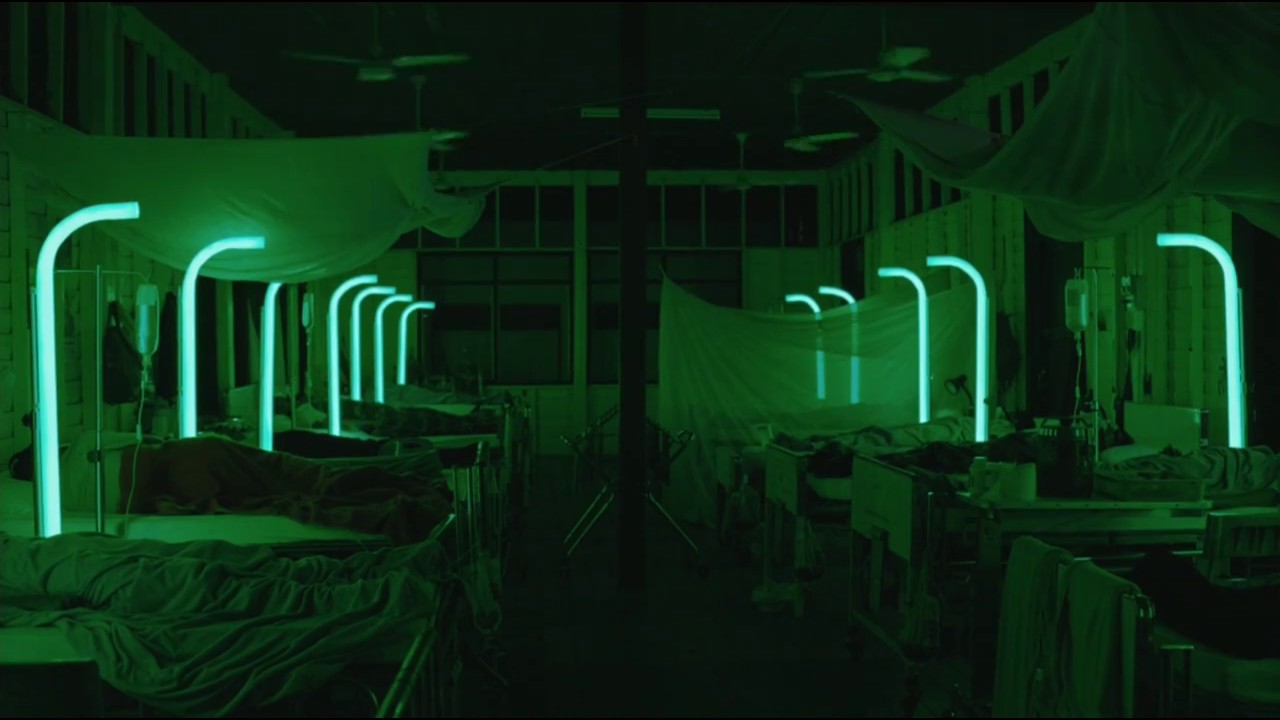
This post is about losing my mum and processing some feelings through a bunch of Apichatpong Weerasethakul films I watched one weekend in April 2021, mainly Cemetery of Splendour.
***
Cemetery of Splendour is, on the surface, a film about soldiers in a hospital in Khon Kaen, a small town in the northeast of Thailand. The soldiers have been struck down by an undiagnosed narcoleptic illness: in bed and unconscious, hooked up to oxygen machines and catheters as doctors try to find a cure and nurses care for their stricken bodies. One nurse on the ward, Jen, develops a close bond with a soldier, Itt, when she realises he has no family to attend him. Their relationship evolves through a series of quiet, tender encounters and moments of gentle intimacy, like Jen washing Itt’s body while he sleeps. Also wandering the ward is a medium, Keng, who is able to act as conduit for the nurses and family to speak to the soldiers as they lie in their sleep-state.
Instances of death and illness are presented as sites where reality collapses. Sites where medical sciences fail, and the mythic starts to seep in through the fissures. The soldiers’ dreams become their only tether to life, and so their unconscious worlds spill over into the real. Itt and Jen develop their relationship through Keng, as the viewer drifts further into this hypnotic unreality populated by ghosts, strips of neon lighting, and the constant repetitive thrumming of fans and water-wheels. With the boundaries between the real and the dreamlike breaking down, supernatural explanations of the narcoleptic illness become as good as any medical one.
It has now been six months since my mum passed away suddenly from ovarian cancer. Watching Cemetery of Splendour today, I think back to my family’s last days with her in the hospice, bedridden, hooked up to a catheter and oxygen machine. The nurses would drift in and out of the room to wash her, turn her, make sure that the machines and drugs keeping her comfortable were all working smoothly. My mum would for her part drift in and out of consciousness, trying to give voice to a want or need whenever she could, getting frustrated with us whenever we were unable to work out what she was trying to communicate. She would claw at her oxygen mask, and we had no way of knowing if this was because it was uncomfortable, if she didn’t want to suffer any more, or if she was even aware she was doing it. The nurses assured us it was the latter.
In Cemetery of Splendour, Keng is able to give the soldiers a voice. Traversing the liminal spaces between the hospital and the dreamworlds these characters now exist in, she allows loved ones a way of speaking across that divide. It’s heartbreakingly touching how these conversations largely deal with the everyday and the mundane minutiae of the characters’ lives, only occasionally venturing into the surreal. I would have given anything to be able to hold some last, lucid conversations with my mum in those final days, if only just to ease her frustrations at being unable to communicate with us. One of the last intelligible words she spoke before passing was ‘cake’, and I’ll never know why, or what thought brought this out. Instead of Keng, we had the occasional visit from the hospice chaplain, offering well-meaning but empty platitudes about Seamus Heaney and ‘circles of affection’.
There’s a line in Cathy Linh Che’s poem I walk through the trees, mourning. about ‘the stutter of a body’s broken grammar,’ which I think about a lot now. About how, in the act of dying, the body falters in its movements, and in the act of mourning language fails us, and where those moments intersect in those suspended days of a protracted death. In her final weeks, my mum’s body began to build up fluid due to a blockage caused by the cancer. With operating not an option, the only thing left to do was drain her, eventually putting a valve in her, like a keg. I will never forget the shock felt at realising just how crude our medical responses still are to the complexities of a body breaking down.
***
Late-stage cancer diagnoses are passed down like death sentences. But the reality of it only set in over a series of moments, sometimes the smallest of things: I remember New Year’s Eve 2019, where every year previously I would have a call with my parents at midnight to say ‘Happy New Year!’ and have a chat. That year, my mum had just started her chemotherapy and had gone to bed early feeling ill. When lockdown took effect, I was denied the ability to visit my parents, but this also incubated me to a degree from what the chemo was doing to my mum. Her voice sounded pretty much the same as it always had on the phone, so it wasn’t until our first video call a couple of months in that I saw how much she’d changed.
The circumstances of the pandemic, the enforced siloing and distancing, all created a derealising effect for me through this. But something else had been going on since February 2020 too. I’d recently gone to a conference in Malta, during the time when coronavirus was still confined in the news to China and regions of Italy, and very much associated with respiratory problems only. Shortly after getting home, I started to feel exhausted and couldn’t think clearly, but put it down to conference flu and depression over my mum’s illness.
Then, one evening, I was sat at my laptop when something triggered in my brain which I can only describe as a feeling like an elastic band snapping. Everything in the room started spinning and twisting, turning upside down. I collapsed on the floor and couldn’t move or call out for a while, before managing to crawl into bed. I called my then-partner who stayed on the phone with me until I’d calmed down, and we agreed I should go to see a GP. This incident was the catalyst for a series of other symptoms, from vasculitis, pressure in my head, headaches, permanent tinnitus, and what’s since been described as ‘brain fog’, which I feel undersells the massive cognitive impairment involved.
This was well before the effects of ‘long COVID’ had started to be catalogued and acknowledged, so my GP ran some blood tests looking for things like anaemia and cancer, and when nothing showed up I was advised to keep monitoring the symptoms. I had just started a new job, and didn’t want to take any extended time off. I didn’t really know what I’d put as a reason for sick leave even if I did. The symptoms would come and go in waves lasting weeks at a time, with each recovery making me feel like I’d imagined the whole thing. I think this confusion around the symptoms stopped me seeking help much sooner, even as I felt more and more certain that what I was suffering was as much physical as psychological.
Drifting in between states of reality and unreality, it also felt a lot like dissociation, inseparable from a mental collapse I was falling into watching my mum decline. In late June 2020, my dad called to let me know that my mum’s chemo hadn’t worked, that life-extending surgery wouldn’t be an option, and that I needed to come home as soon as I was able. The surgery had been the last remnant of hope for my mum, that she might at least have a couple more years with us if nothing else. We spent those last weeks as best we could, but it shocked everyone how quickly the cancer was spreading. Plans for ways we could spend the next few months turned into plans for the next few weeks, and then days, until it began to dawn on us that these were the final days.
One of the final scenes in Cemetery of Splendour sees Jen sat next to Keng, who is occupied by the spirit of Itt, on a park bench. She turns to them and says, “You will live long, Itt. Our metabolism slows while we sleep. Save yourself for a better future.” A central theme of the film is this idea of youth, long life, living well, and by that nature dying well. Jen sees a long life as good in itself, even if Itt will spend it in a near-permanent state of sleep. The better future is an undefined imaginary. With my mum’s health deteriorating more rapidly than any of us expected, our parameters for how to spend our time as a family ‘well’ shrank to the point where conversations about possible staycations became conversations about her making it to January to meet her first grandchild. Imaginary futures became less and less ambitious, until they became an attritional exercise in staying alive for its own sake.
Above all else, my mum was adamant that she didn’t want to die in hospital, in a lifeless, clinical room that smelled of disinfectant and plastic. As it was, even this was taken out of our control, when I was woken up by my dad at 3:00am one morning in late summer. My mum couldn’t catch her breath and was asphyxiating, and we called an ambulance. Sat waiting for the paramedics, it was the last moment I’d spend with her in the house.
***
After my mum’s funeral in October, there were a quick succession of traumatic triggers: my sister’s birthday, Christmas, my sister giving birth, my birthday, my dad’s birthday. All meant to be joyous events, but in effect just reminders of the loss, which it took all my strength to get through. I didn’t book another appointment with the GP until late February of this year, when my mum’s birthday and Mother’s Day were looming and I was at the point of breakdown.
A month on, I have a diagnosis of long COVID, depression and PTSD. I am on a variety of medications. I have two therapy referrals. I have a referral to a ‘tinnitus clinic’ at the ENT department at Oxford Hospital. The GP said that my eardrums had retracted a lot, and that this could be the likely cause of the tinnitus and head pressure, but that there’s a chance it’s as much a cognitive issue. Almost exactly a year on from my collapse and first appointment, I am now catalogued and in the system, which is comforting in its own way, even if there might be no cure or treatment. The side effects of the sertraline have been minimal, but so far the effects have been as well. The most notable change in my body was the total inability to sit still or stop moving. In my first week on the drug, I was going on two runs a day, as well as a walk, which obviously then caused problems with my long COVID symptoms. I’m starting to find a balance now, but it’s hard.
As my symptoms have dragged on, compounded by traumas, the pandemic, and declining mental health, I feel more and more as if my own structures of reality have become less firm, more ephemeral. The best way I’ve been able to communicate my experience of long COVID is that it’s like dreaming while awake. That feeling of limbs being heavier, thoughts slower, a dissonance between cause and effect, but also the complete awareness that you’re fully conscious.
Truthfully, I had already been in pretty bad shape going into the pandemic. 2018 had been an incredibly traumatic year for a number of reasons, not least the deaths of my grandparents to heart disease and dementia respectively. I felt like I had lost some essential parts of myself in that year, pieces I was still trying to recover when my mum received her diagnosis of late-stage ovarian cancer in 2019.
Watching Cemetery of Splendour again made me consider the nature of this, and whether it’s always been this way. It’s convenient for us to think of ourselves as a cohesive, unified whole, when I think the reality is we’re in a constant state of flux, always in a stage of becoming something else. What’s left behind is buried away in the brain, with varying degrees of success. These past selves are the ghosts stalking the hospital ward, the voices and spirits occupying Keng’s body. They manifest in dreams and in the subconscious. They talk of ancient, beautiful cities, palaces filled with mirrors, warring dynasties. As the soldiers slip into past lives, repetitions of memories playing out through Keng, how much is the narcolepsy also an act of escape from an unbearable present? Jen tells Itt to save himself for a better future, but with all possibilities being closed off by illness, where else is there to go?
My own past selves occupy much smaller, sadder spaces. My mum was moved from hospital to a hospice: still a clinical space, but calmer, and more attuned to the specific fluctuations of death and grieving. Most importantly, me, my dad and my sister were allowed to visit her here. We spent the next few days and nights attending, keeping watch, keeping vigil. We found small moments of peace or humour, taking breaks to wonder around the gardens. When she was awake, I’d sometimes try to create an imagined future for my mum where I wheeled her out into the gardens there, and she got to see the flowerbeds, the stray cat lounging in the sun, the towering oaks where squirrels showered us with acorn shells from above. But we both knew she was trapped in her room, hooked to her oxygen machine, underneath the glare of the lighting panel above her bed.
In the end, she passed away with me, my dad and my sister all there in the room with her, which I think was probably the best scenario we could have hoped for by that point. I left a part of myself behind in that hospice room. It’s that part of me that returns in dreams most frequently at the moment, with haunting memories of the bare strip lighting and the metronomic thrum-and-hiss of the oxygen machine. But this is also the last space I saw and spoke to my mum in, and I’m not quite ready to let go of that yet.
***
One of the most moving scenes in Cemeteries of Splendour is when Keng, inhabited by Itt, washes and massages Jen’s lame leg in a kind of benediction, using a mix of goji berry and Ginkgo biloba that Jen had made for Itt. When we’re introduced to Jen, Weerasethakul offers no initial explanation as to why she walks on crutches. The story of this comes out slowly in natural conversation as the film progresses, starting from when we discover one of her legs is shorter than the other, and that there was an accident of some kind. With no possibility of affording an operation at 10,000 Baht per centimeter of her body, she has to come to terms with her lame leg, even as she dreams of an eventual reprieve. The hope and material possibility of surgery seems as unrealistic as anything her spiritual prayers or small gifts to the local shrine might offer.
We don’t know if Jen will ever recover, but the moment is such an emotional and tender one that it almost doesn’t matter. It is the act of kindness in itself that matters. The captivating thing about Weerasethakul’s films is how he finds these sites of trauma, and transforms them into something graceful. He doesn’t flinch away from the realities of failing bodies, but draws out a kind of poignancy from them at the same time. Worlds of neon light and golden spectral palaces built on top of cemeteries.

 Point.Click.Repeat